

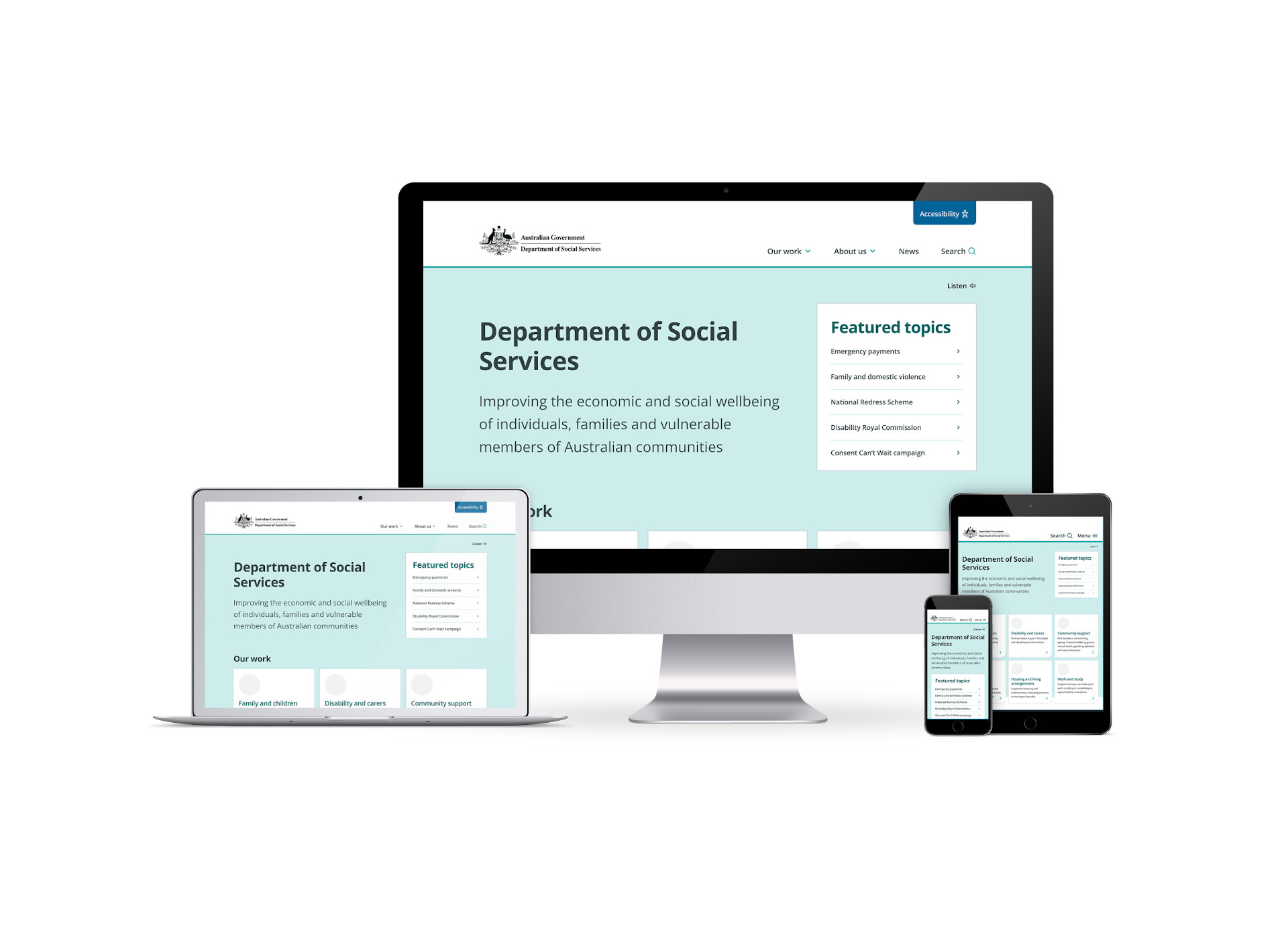
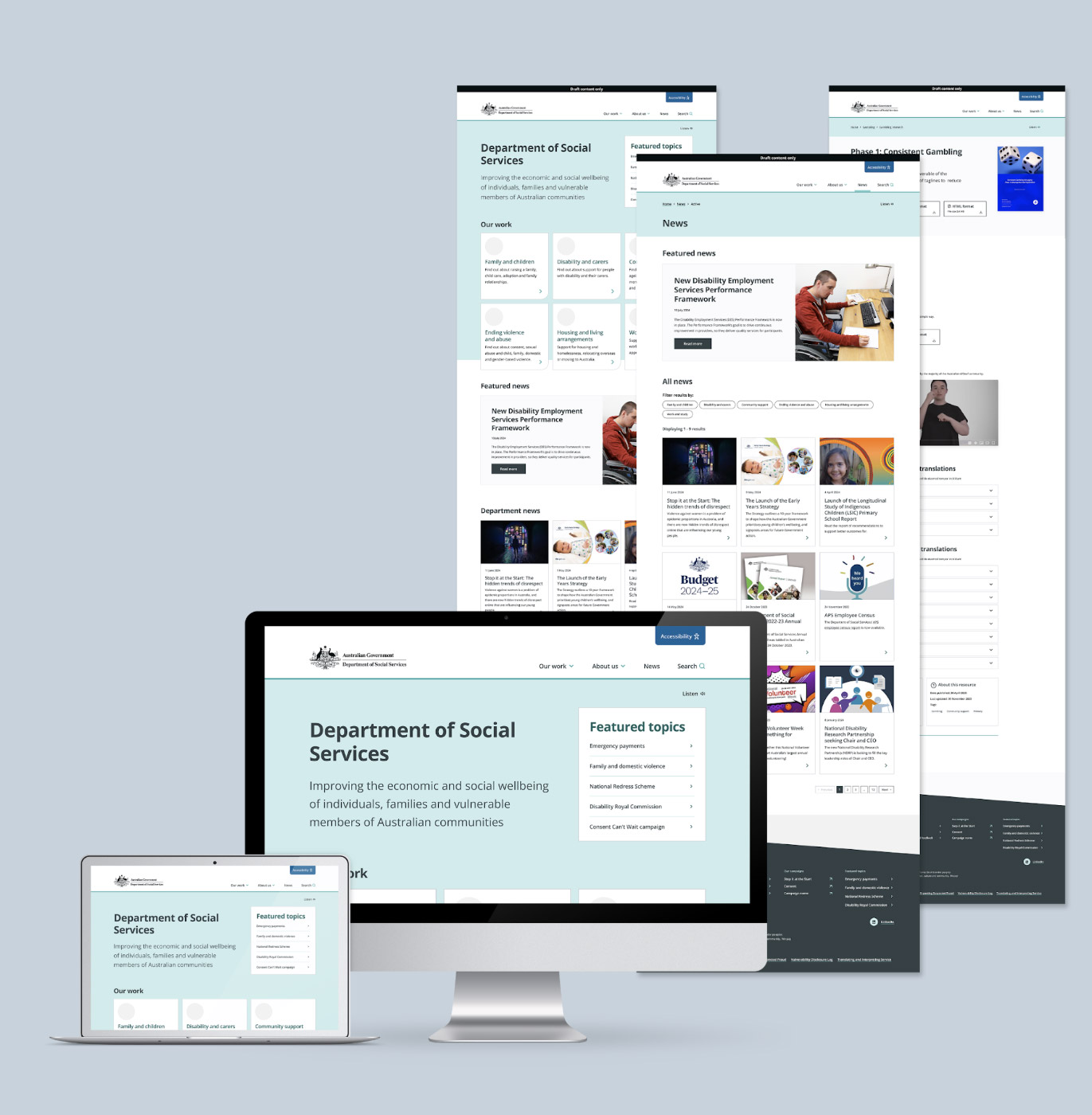
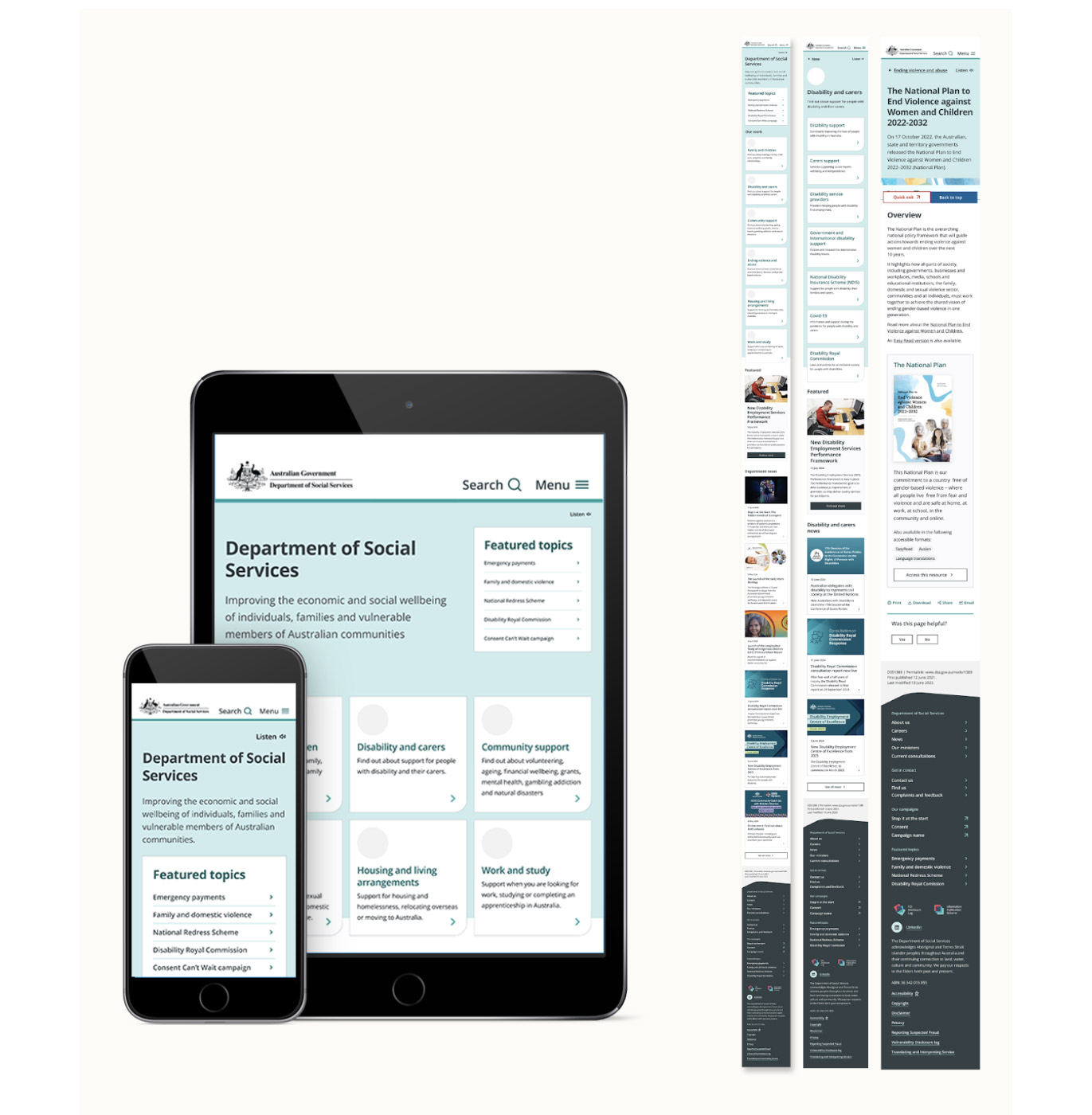
The Department of Social Services (DSS) website was an outdated platform with significant usability challenges. It suffered from poor information architecture, a disorganised information flow, complex navigation, and ineffective search functionality. The content lacked clarity and was overwhelming, while the site failed to meet modern usability standards outlined by Digital Service Standards 2.0 (DSS 2.0).
The website’s responsive behaviour was suboptimal, resulting in a poor user experience, particularly on mobile devices. Additionally, the site’s breadcrumb navigation, search filters, and overall navigation structure were unintuitive. Built on the Drupal content management system using the Civic theme, the site required a comprehensive redesign to better serve its users.
…human-centred design practices across teams, guided us through complex decisions, and translated policy and technical constraints into intuitive, accessible experiences...
We focused on gaining a deep understanding of the users’ needs through extensive research and analysis, designing a more intuitive and accessible experience, and delivering a future-ready solution aligned with DSS 2.0 standards.
Domain
Domain:
Federal Government
Citizen centred design
Policy compliance
Content Architecture
Design system
Areas:
Responsive Web design
Search & Content types
Site navigation
WCAG and DSS 2.0 compliance
Skill and Expertise:
Usability Audits
Content strategy
Low-Hi Fi prototypes
User interviews and testing
User flows & Empathy maps
Qual and Quan research
Dev support & Guidelines

The redesign aimed to:
- Revamp the outdated information architecture
- Simplify navigation and improve content flow.
- Ensure compliance with DSS 2.0 usability standards.
- Enhance the site’s mobile responsiveness and user experience.
- Improve site-wide navigation, breadcrumbs, and search functionality.
- Increase accessibility for seniors, people with disabilities, and carers.
Key Activities:
- User Research:
- Local Peoples conducted two user research sessions with 16 participants, representing key user personas, including seniors, individuals with disabilities, and carers.
- The team validated user personas and gathered valuable insights into their goals, pain points, and behaviours.
- Customer Journey Mapping:
- Local Peoples mapped current-state customer journeys, identifying key friction points in navigation, content discovery, and the overall user experience.
- Future-state customer journeys were developed, offering clear and accessible paths for users to efficiently access the services and information they needed.
- Wireframing and High-Fidelity Designs:
- Low-fidelity wireframes were created to establish a new information architecture and navigation structure.
- High-fidelity designs followed, with a focus on a mobile-first approach, ensuring full responsiveness across all devices.
- Mobile-First UX Design:
- The mobile experience was prioritised, with optimisation for layout, navigation, and content flow on smaller screens.
- All interactions were made touch-friendly, and content was designed to be easy to read and navigate on mobile devices.
- User Interviews and Usability Testing:
- Local Peoples conducted user interviews and usability testing to validate design decisions, iterating based on user feedback.
- Both qualitative and quantitative research methods were employed to gain a comprehensive understanding of user needs.
- Design System and UI Component Creation:
- A new Design System Manager was developed, along with an asset library to ensure consistency across all UI elements.
- UI components and dev-ready assets were created, optimised for performance and accessibility.
The redesigned DSS website, delivered by Local Peoples, offers a vastly improved user experience. The new information architecture is clear and intuitive, making it easier for users to find services and information.
The mobile-first approach has significantly enhanced usability on smartphones and tablets, while compliance with DSS 2.0 standards has made the site more accessible to a broad range of users, including seniors, individuals with disabilities, and carers.